








Registering Your Rental Property
What Every West Midlands Landlord Needs to Know
The Renters’ Rights Act Phase Two: Who Must Register and How to Prepare
The second phase of the Renters’ Rights Act 2025 creates England’s first national register of landlords and the homes they let.
From 15 December 2026, every landlord letting on an assured or regulated tenancy must register themselves and each property through the government’s Register your rental property service. The West Midlands is the first region required to do it. Properties in Birmingham, Solihull, Warwickshire, Worcestershire and the rest of the region must be registered by 14 March 2027.
Registration comes with an annual fee per property and penalties for landlords who miss the deadline.
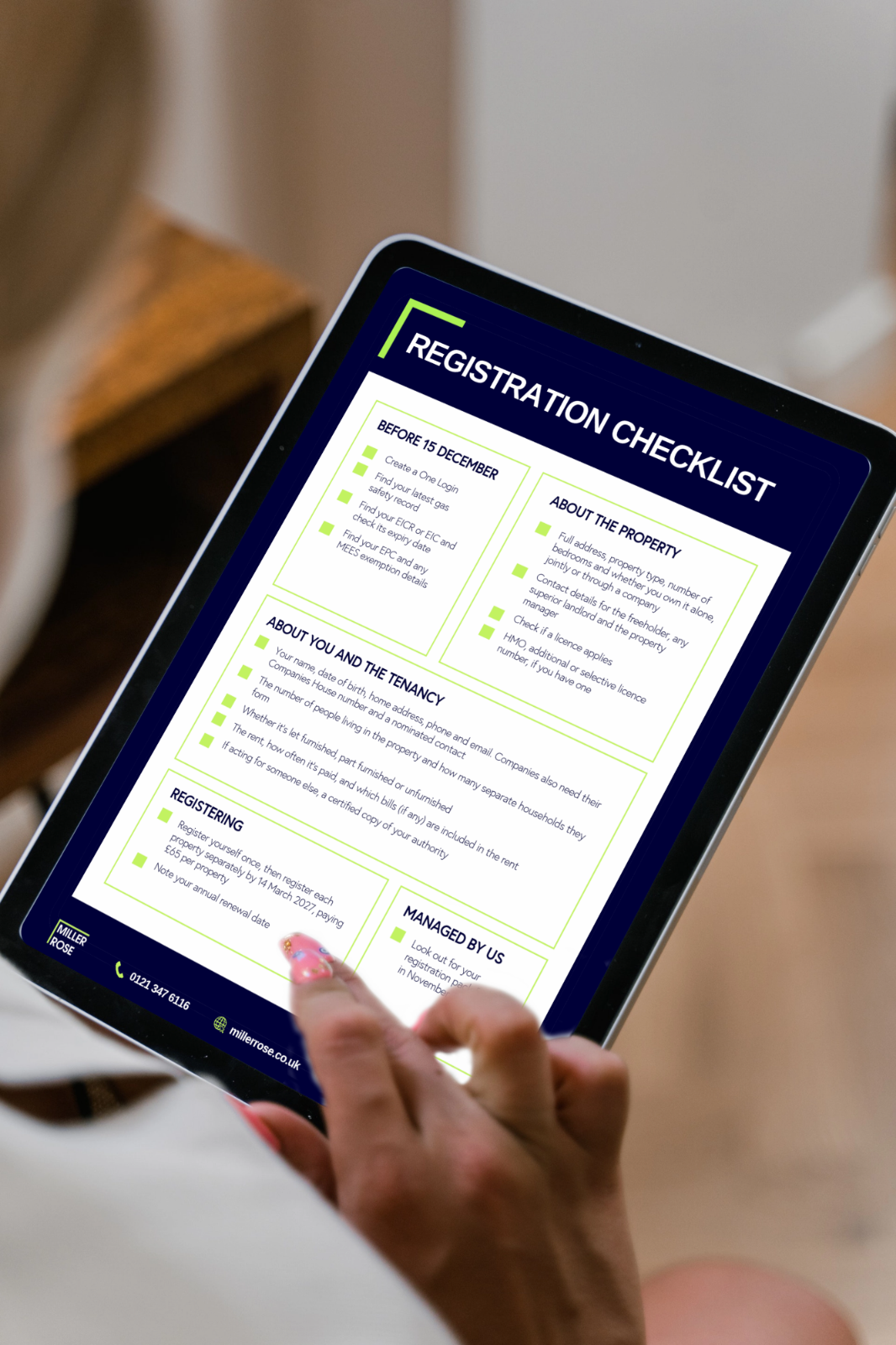
Download the quick guide for the key dates and a registration checklist you can work through before the service opens.
Download Your Free Guide
"*" indicates required fields


The Renters’ Rights Act 2025 is coming into force in two phases. The first came into force on 1 May 2026 and changed how tenancies work, with periodic tenancies replacing fixed terms and section 21 removed.
The second phase is about enforcement. Its main measure is the Private Rented Sector Database, which landlords use through the Register your rental property service.
Until now, councils have found rental properties through licensing schemes and complaint-led inspections, so their view of local renting has been partial. The database gives housing officers:
- One list of let properties across their area
- Contact details for each landlord and anyone managing the property
- The safety certificates and EPC behind each let
- A clear view of where a certificate is missing or out of date
The government also plans to let tenants check whether a landlord meets key legal requirements before they agree a tenancy. It has not yet confirmed which details will be public.
What Phase Two Changes for Landlords
If your certificates are in date and your records are in order, registering means entering details and uploading documents you already hold. Registration also connects to other parts of the Act:
- Councils will see missing or expired certificates in one searchable system
- You generally won’t be able to get a possession order unless you and the property are registered, apart from on anti-social behaviour grounds
- Letting a property without active registration can lead to a civil penalty
- Future rules will require registration before a property is advertised, with your landlord and property identifiers shown on every listing
Registration sits alongside existing licensing. Birmingham’s selective licensing scheme covers 25 of the city’s 69 wards and runs until June 2028. A property in a licensed ward still needs its licence, and the licence number goes on the register.

Does the Register Apply to You and When?
You need to register if you let a property on an assured or regulated tenancy. Since 1 May 2026, new private tenancies in England are assured periodic tenancies, so this covers most private landlords.
You register yourself once as the landlord, then register each property separately. For now, the duty covers properties that are let, or that become let during the rollout. Under future legislation, empty properties will need registering before they’re marketed.
Supported exempt accommodation is excluded. So is student accommodation that’s university-accredited or in a private purpose-built block, although ordinary shared student houses are included.
The deadline is set by where the property is. A landlord who lives in London and lets a flat in the Jewellery Quarter works to the West Midlands deadline. If you own property in more than one region, you can register everything from 15 December, and each property must be registered by its own region’s deadline.
Registration timetable
Key Dates
| Region | Registration required from | Deadline |
|---|---|---|
| West Midlands | 15 December 2026 | 14 March 2027 |
| East of England | 15 January 2027 | 14 April 2027 |
| East Midlands | 15 February 2027 | 14 May 2027 |
| South East | 15 March 2027 | 14 June 2027 |
| Yorkshire and Humber | 15 April 2027 | 14 July 2027 |
| North West | 15 May 2027 | 14 August 2027 |
| North East | 15 June 2027 | 14 September 2027 |
| London | 15 July 2027 | 14 October 2027 |
| South West | 15 August 2027 | 14 November 2027 |
How Registration Works in Practice
Your GOV.UK One Login
You need a GOV.UK One Login to use the service. It’s free to set up, and only you can create it. An offline route will be available for landlords who can’t register online.
The Information You’ll Provide
The form asks for details about you, the property, the tenancy and the property’s safety documents. You’ll upload your gas safety record and your EICR or EIC with its expiry date, confirm the EPC and any MEES exemption, and add any HMO, additional or selective licence number.
The Fee and Renewal
The fee is £65 per property per year, and registration is renewed annually. During the rollout the fee is pro-rated, so you pay the same whenever you register in your window.
If an Agent Manages Your Property
You remain responsible for starting and completing your registration. Where you agree, your letting agent will be able to add certain information for you, including safety certificates. The government will publish guidance for agents before launch.

Where Landlords Get Caught Out
Common mistakes include:
- Confusing the 15 December opening date with the 14 March 2027 deadline
- Using their home region’s deadline for a property in another region
- Expecting their letting agent to complete the registration for them
- Leaving certificate renewals until the registration window opens
- Assuming a selective licence means the property doesn’t need registering
Rent Increase Disputes Are Moving Too
Phase two also changes how tenants challenge rent increases. Disputes are moving from the First-tier Tribunal to HMRC’s Valuation Office. No start date has been set, so challenges still go to the tribunal for now. We’ll update this page when a date is confirmed.

What's Included in the Guide
The quick guide covers:
- Why the register exists and where it fits in the Renters’ Rights Act
- Who must register, with the West Midlands dates
- The fee and how renewal works
- The information and documents you’ll need
- How registration affects possession, advertising and licensing
- How we’re preparing the properties we manage
- A registration checklist you can work through before 15 December
- The penalties for missing the deadline
Supporting Landlords Across Birmingham and the West Midlands
The West Midlands registers first, so landlords here will use the system before the rest of England. As ARLA Propertymark members, we’ll brief landlords as soon as the agent guidance is published. For the properties we manage, we are:
- Checking every certificate and renewal date
- Renewing anything that would expire before 14 March 2027
- Building a registration pack for each landlord, ready for the final details from the government
- Adding licence numbers where they apply
- Checking registration status at every new instruction
If you manage your own property, we can check your paperwork against the registration list before you start. If it also needs a selective licence, our licensing inspection report covers what the council asks for.
Making Tax Digital also reaches more landlords from April 2027, a few weeks after the West Midlands deadline. Read our Making Tax Digital guide.
How to Prepare for Registration
Most of the preparation can be done now, before the service opens. A practical starting point is to:
Set up your GOV.UK One Login
Create your account now so it’s ready when registration opens on 15 December.
Check your certificates
Find your gas safety record, EICR or EIC and EPC, and book renewals for anything expiring before 14 March 2027.
Confirm your licensing position
Check whether your property needs an HMO, additional or selective licence, and have the licence number to hand.
Gather your property and tenancy details
Note the number of occupants and households, the furnished status, the rent and any bills included, plus contact details for the freeholder and property manager.
Speak to your letting agent
Agree which details and documents they will prepare and upload, and which parts you’ll complete yourself.
Download Your Registration Guide
Fill out the form to download the quick guide, including the registration checklist.
If you have questions about how the register affects your properties, the Miller Rose lettings team is happy to talk it through, whether we already manage your property or you’re getting in touch for the first time.
Download the free quick guide for the Renters' Rights Act and discover what it means for Landlords in the West Midlands.
Frequently asked questions
What is the Register your rental property service?
It’s the government service for the Private Rented Sector Database, created by the Renters’ Rights Act 2025. Landlords use it to register themselves and each property they let in England.
Is the landlord register part of the Renters’ Rights Act?
Yes. The register is the main measure in the second phase of the Act, which focuses on enforcement. The first phase came into force on 1 May 2026.Yes. The register is the main measure in the second phase of the Act, which focuses on enforcement. The first phase came into force on 1 May 2026.
When do West Midlands landlords need to register?
Registration opens on 15 December 2026, and West Midlands properties must be registered by 14 March 2027.
Do all landlords have to register?
Landlords letting on assured or regulated tenancies must register, which covers most private landlords. Supported exempt accommodation is excluded. So is student accommodation that’s university-accredited or in a private purpose-built block, although ordinary shared student houses are included.
How much does registration cost?
£65 per property per year, renewed annually. The fee is pro-rated during the rollout.
I live outside the West Midlands. Which deadline applies?
The deadline follows the property’s location. A West Midlands property must be registered by 14 March 2027, wherever the landlord lives.The deadline follows the property’s location. A West Midlands property must be registered by 14 March 2027, wherever the landlord lives.
What do I need to register?What do I need to register?
A GOV.UK One Login, your personal or company details, details of the property and tenancy, your gas safety record, your EICR or EIC, your EPC, and any licence number.
Can my letting agent register for me?
You must start and complete the registration yourself. With your agreement, your agent will be able to add certain information, including safety certificates.
What happens if I don’t register?
Letting or advertising an unregistered property can lead to a civil penalty of up to £7,000. A further breach within five years, or knowingly giving false information, can lead to a penalty of up to £40,000 or prosecution. Unregistered landlords also generally can’t get a possession order.
Does registration replace selective licensing?
No. Birmingham’s selective licensing scheme continues alongside the register until June 2028, and a property in a licensed ward still needs its licence.No. Birmingham’s selective licensing scheme continues alongside the register until June 2028, and a property in a licensed ward still needs its licence.
How are rent increase disputes changing? How are rent increase disputes changing?
Challenges to rent increases are moving from the First-tier Tribunal to HMRC’s Valuation Office. No start date has been set, so disputes still go to the tribunal for now.
Explore the latest property News and Resources

Registering Your Rental Property in Line with the Renters’ Rights Act
14 October 2026
We’re four editions into this series now, and increasingly some of the Landlords I work with have been suggesting topics...

Awaab’s Law and private landlords: What you need to know
9 October 2026
Awaab’s Law has already changed the rules for social housing landlords. Now, private renting could be next. The government is...

Estate agent licensing: why I welcome it
30 September 2026
By Andy Butts, Managing Director, Miller Rose. 30 September 2026. On 29 September the government confirmed its plans to introduce...