








Making Tax Digital
What Every Landlord in England Needs to Know
What It Means, Who It Applies To, and How to Stay Compliant
Making Tax Digital has been delayed, reshaped, and discussed for long enough that many landlords have treated it as something that will eventually settle into place.
That position is no longer sustainable. Making Tax Digital for Income Tax is now a phased legal requirement, and it changes not just when tax is reported, but how records are maintained throughout the year.
For landlords whose income meets the relevant thresholds, the shift from an annual process to an ongoing system of reporting is not optional.
Download the complete guide to understand how the system works in practice, what changes for you, and how to prepare properly.

What Making Tax Digital Actually Means
Making Tax Digital is often described as a move from paper to digital, or from manual to automated systems.
The more accurate way to understand it is as a structural change to the tax reporting model. The traditional approach, maintaining records across the year and submitting a single Self Assessment return, is replaced by a system that requires continuous record-keeping and periodic reporting.
For landlords, this matters because many existing processes are built around an annual cycle:
- Records gathered retrospectively
- Accounts prepared once per year
- Tax calculated and filed as a single exercise
Making Tax Digital does not adapt that model, it replaces it with one that runs throughout the year.
What Changes Under Making Tax Digital
The most important point to understand is that Making Tax Digital does not just introduce additional steps to the existing process, it introduces a different process entirely.
From the point at which Landlords fall within scope, you will be required to:
- Maintain digital records of income and expenses throughout the year, rather than reconstructing them at year-end
- Submit quarterly updates, providing a running summary of your financial position
- Use MTD-compatible software to maintain and submit those records
- Complete a year-end finalisation process, confirming your overall tax position
These requirements are not independent of one another, they form a continuous system where each stage depends on the accuracy and consistency of the previous one.
For landlords whose current approach is based on an annual reconciliation, the shift is operational rather than administrative.


Does Making Tax Digital Apply to You and When?
How Making Tax Digital Works in Practice
Digital Record-Keeping
Landlords are required to maintain digital records of income and expenses using compatible software. This is not a requirement to convert existing records into digital form once a year.
It is a requirement to maintain those records digitally and continuously, so that they are available and accurate at any point in time.
The quality of these records directly determines how manageable the rest of the process will be.
Quarterly Updates
Four times per year, a summary of income and expenses must be submitted to HMRC. These updates:
- Provide HMRC with a running view of your financial position
- Allow you to understand your likely tax position earlier in the year
- Do not create an immediate tax liability
They are not four separate tax returns, but they are a required part of the reporting process and must be completed before the year-end submission can be finalised.
Year-End Finalisation
At the end of the tax year, your overall position is confirmed and submitted.
This stage is broadly similar to the existing Self Assessment process, but it is completed through MTD-compatible software and is dependent on the quarterly updates having been submitted accurately throughout the year.
What This Means For Landlords
The impact of Making Tax Digital depends less on the size of a portfolio and more on how it is currently managed.
For landlords already maintaining accurate, up-to-date digital records, and working within a structured system, the transition is likely to involve adaptation rather than overhaul.
For those operating on a more traditional model where records are compiled retrospectively, receipts and expenses are organised at year-end and the accountant relationship is primarily annual, the change is more fundamental.
Making Tax Digital requires that financial information is:
- Recorded as it occurs
- Maintained consistently
- Available for reporting at defined intervals
This represents a shift from a reactive process to a continuous one.
Where Landlords Get Caught Out
A significant number of landlords misunderstand how Making Tax Digital applies to them, not because the rules are unclear, but because the assumptions carried over from the current system no longer hold.
Common issues include:
- Assuming that income is assessed on profit rather than gross receipts
- Expecting HMRC to notify them directly if they fall within scope
- Treating quarterly updates as optional or administrative rather than required
- Underestimating the time required to establish consistent record-keeping
There is also a tendency to view the introduction of new systems as primarily technical.
In practice, the greater challenge is behavioural, moving from a once-a-year process to one that operates continuously requires consistency, not just software.
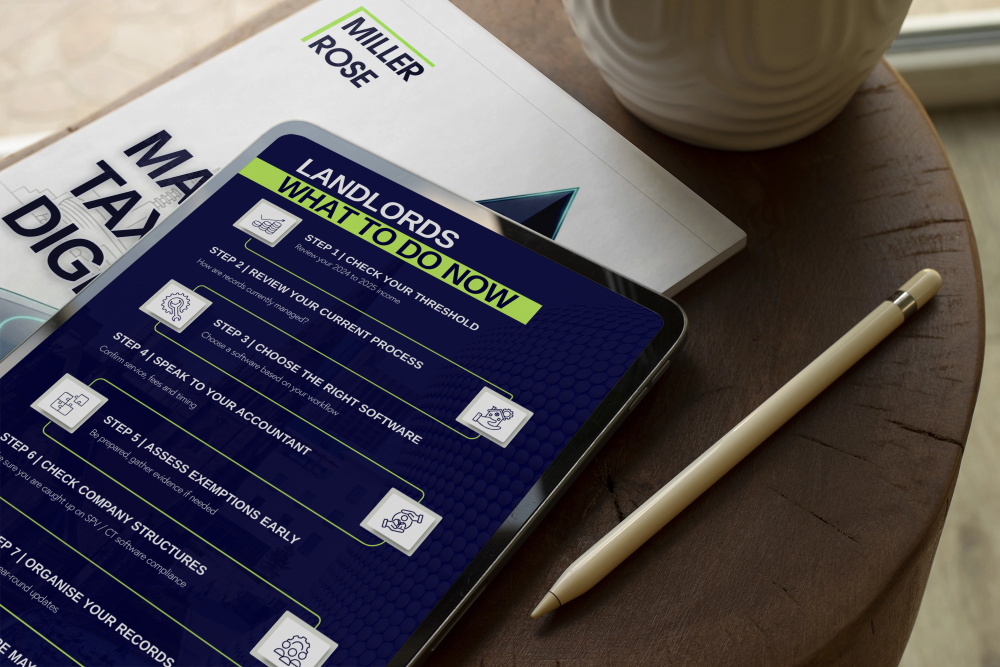
What’s Included in the Guide
The Making Tax Digital guide provides a detailed breakdown of:
- What Making Tax Digital actually changes
- Who it applies to and how thresholds are calculated
- How the reporting process works across the year
- The practical implications for landlords
- Common misconceptions and compliance risks
- A structured approach to preparing for the transition
It is designed to give landlords a clear understanding of what is required, and how to approach it in a way that is manageable and sustainable.
Supporting Landlords Across Birmingham and the Midlands
Across Birmingham and the wider Midlands, many landlords continue to operate within an annual accounting framework.
Making Tax Digital introduces a different expectation, one that requires:
- Ongoing record-keeping
- Greater consistency in financial management
- A more integrated relationship between landlord, agent, and accountant
As regulatory requirements become more structured, the way portfolios are managed becomes increasingly important.
Landlords who build these processes into their day-to-day operations are better placed to adapt as requirements evolve.

How to Prepare for Making Tax Digital
Preparing for Making Tax Digital is less about meeting a single deadline and more about establishing a process that works reliably over time. A practical starting point is to:
Review your income position
Use your most recent Self Assessment return to calculate total gross income from property and self-employment.
Assess your current process
Consider whether your existing approach to record-keeping would support accurate reporting throughout the year.
Understand your reporting requirements
Familiarise yourself with the structure of quarterly updates and how they will be managed.
Speak to your accountant
Clarify how Making Tax Digital will be handled, what role they will play, and what will be required from you.
Move towards consistency
Begin transitioning to a system where income and expenses are recorded as they occur, rather than retrospectively.
Landlords who approach this as an operational adjustment rather than a last-minute compliance exercise are better positioned to manage the transition effectively.
Download your Making Tax Digital Guide
To find out more about the changes to the rental industry, fill out the form to download your free guide.
If you have questions about how the Making Tax Digital affects your properties, the Miller Rose team is happy to talk it through. Whether you are a landlord we already work with or someone who has not spoken to us before, get in touch.
"*" indicates required fields
Frequently asked questions
What is Making Tax Digital for landlords?
Making Tax Digital is a change to how landlords report income to HMRC. It replaces the annual Self Assessment model with a system that requires digital record-keeping and reporting throughout the year.
When does Making Tax Digital start for landlords?
Making Tax Digital is being introduced in stages, depending on qualifying income. The timing of when it applies to you depends on your income level and the relevant tax year.
Does Making Tax Digital apply to all landlords?
No. Making Tax Digital applies based on income thresholds, meaning some landlords will fall within scope earlier than others as the rollout progresses.
How are Making Tax Digital threshold calculated?
Making Tax Digital thresholds are based on total gross income from property and self-employment combined, before any expenses are deducted.
What income counts towards MTD threshold?
All rental income and self-employment income counts towards the threshold, calculated before costs such as mortgage interest, maintenance, or agent fees are deducted.
Will I need to submit tax returns more often under Making Tax Digital?
Under Making Tax Digital, landlords are required to submit updates throughout the year rather than relying solely on a single annual submission.
Do quarterly updates mean paying tax four times a year?
No. Quarterly updates are for reporting purposes only and do not trigger immediate tax payments, but they are required as part of the overall reporting process.
Do landlords need to use software for Making Tax Digital?
Yes. HMRC requires landlords to use compatible software to maintain digital records and submit updates as part of the Making Tax Digital system.
Does Making Tax Digital apply to limited companies?
No. Making Tax Digital for Income Tax applies to individuals, although separate changes to company filing requirements may still affect landlords operating through company structures.
What should landlords do to prepare for Making Tax Digital?
The starting point is to understand whether you fall within scope and assess whether your current record-keeping process aligns with what Making Tax Digital requires throughout the year.